

Origin · 4 min read
Why Kawane? The Shizuoka Valley Behind Our Tea
The valley does something to the leaf that no amount of care in the mill can add later. It slows it down.
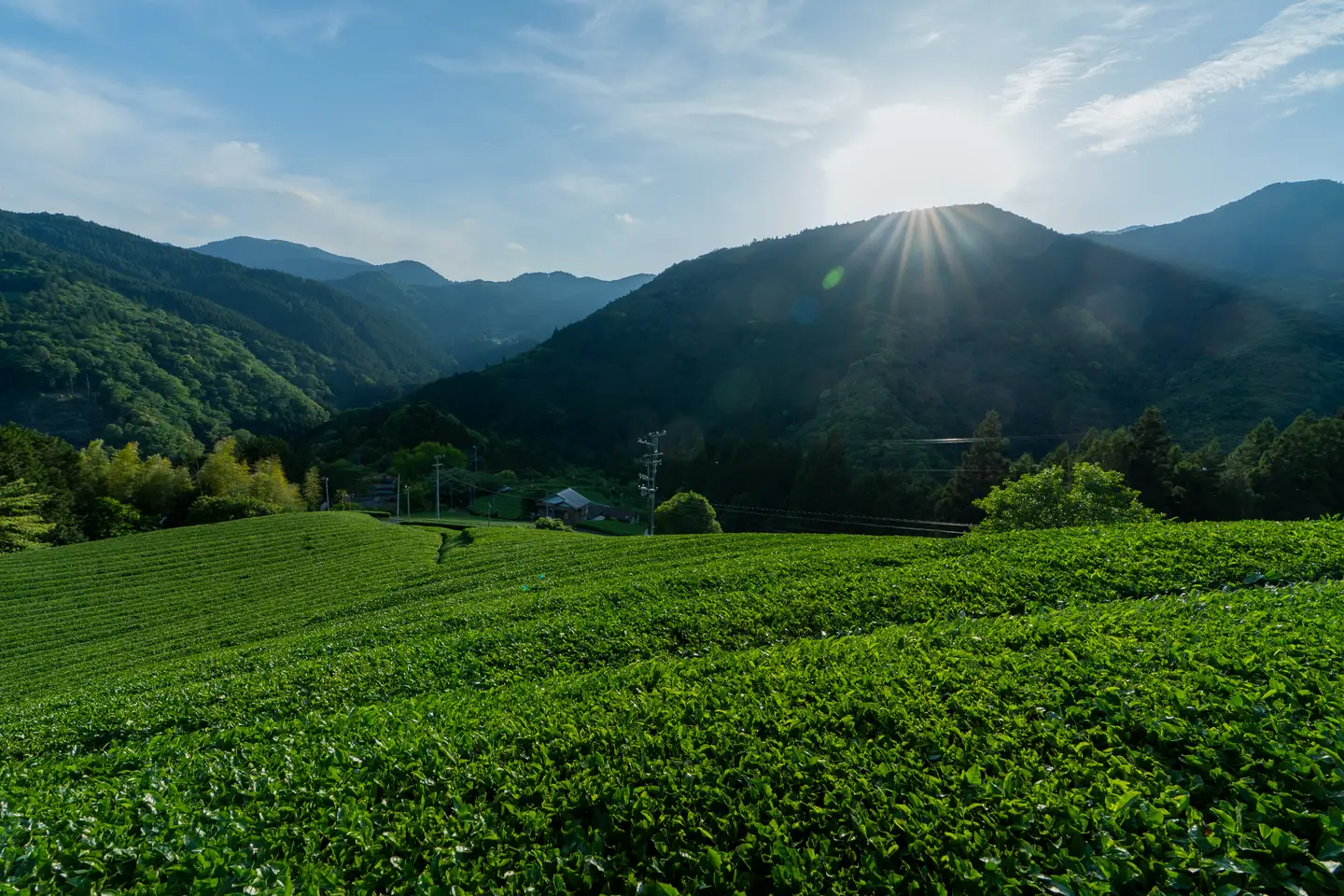
You can buy good equipment. You can hire skill. What you cannot install is a valley — and in tea, the valley is doing more of the work than anything that happens afterwards.
Mist, river and altitude
Kawane sits among misty mountain slopes in Shizuoka, along the Ōi River. Three things there act on the tea at once: persistent river mist, steep altitude, and sharp shifts between day and night temperature.
Their combined effect is to slow the plant down. Growth that would race in a warm, flat, evenly-lit field instead happens gradually, and slow growth concentrates aroma and umami in the leaf rather than diluting them across fast, bulky foliage. It is the same principle that makes marginal climates interesting in wine: a little hardship, in the right direction, makes for a more concentrated result.
What that patience buys
The character people recognise in Kawane matcha — delicate aroma, deep complexity, a naturally balanced sweetness rather than a sugared one — is downstream of that slowness. It is not a processing trick and it cannot be added at the mill.
From that valley to this room
KOKO Kawane exists to shorten the distance between the two ends of that sentence. The tea is grown in Kawane; the shading, the immediate steaming, the drying into tencha and the slow stone-grinding all follow. What arrives in the bowl in Singapore is meant to still taste like where it came from.
That is the whole of the idea, and it is why the phrase on the door is From Farm to Cup rather than anything cleverer.
More reading
What Is Matcha? From Shaded Leaf to Stone-Ground Powder
Most tea is steeped and thrown away. Matcha is the rare one you drink whole — which is why every step before the grinding matters.
Tsuyuhikari and Okumidori: The Two Cultivars We Serve
One is bright, crisp and quick. The other is deep, full and slow. Serving only one would tell half the story.